
Rhodesians are beautiful in appearance, arouse admiration and respect. Rudzielce is one great individuality of the other such will not  which, therefore, do not always follow the instructions of the caregiver. Rhodesians are extremely intelligent and use this intelligence to improve their comfort of life. If you understand that, it's all going to be easier.The key to rhodesian upbringing is what we call controlled freedom.
Raising a puppy we start from the first moment when he arrives at our house and in order not to go crazy such my advice should be to be patient, a lot of patience…. rhodesians are very intelligent, so they cannot develop reflexes of unconditional obedience. R R seems to analyze everything before he does something on command, quickly bored with science, because he does not see the advisability to repeat the same things all the time indefinitely.
The golden rule – we humans are leaders. Commands should be short and always the same , rules clear and transparent – if allowed to lie on the couch , it is slow. If a soft milk-smelling puppy sleeps with us in bed, then the adult dog will also sleep there.
Rhodesian is a dog that values movement first and foremost. People running, active movement will be delighted. RR is often a companion to people running marathons. (can safely run 40 km.) This does not mean that it is not suitable for living in a block with people who like to go for walks. Happy Rhodesian is a rundown Rhodesian. The instinct assigned to group VI hunting to which RR belongs makes itself known. You have to work with our pet from the very beginning to teach him to ignore runners, cyclists, skaters or just running deer, which you will probably meet someday on your way.
Quietly it is not as bad as you think you will find a common language, and therefore a faithful friend, your personal shadow …. which will watch over you even in the shower (it happens)
 RHODESIAN RIDGEBACK
Brief historical figure:
General impressions:
Behavior – Temperament:
Head:
Brainchironic:
The skull should be long (the width of the skull between the eyes and the distance from the occipital tumor to the alloy and from the alloy to the apex of the nose are the same). Flat, wide between the seams. When the dog is calm, there are no wrinkles on the head. The stop should be clearly, but not overly marked.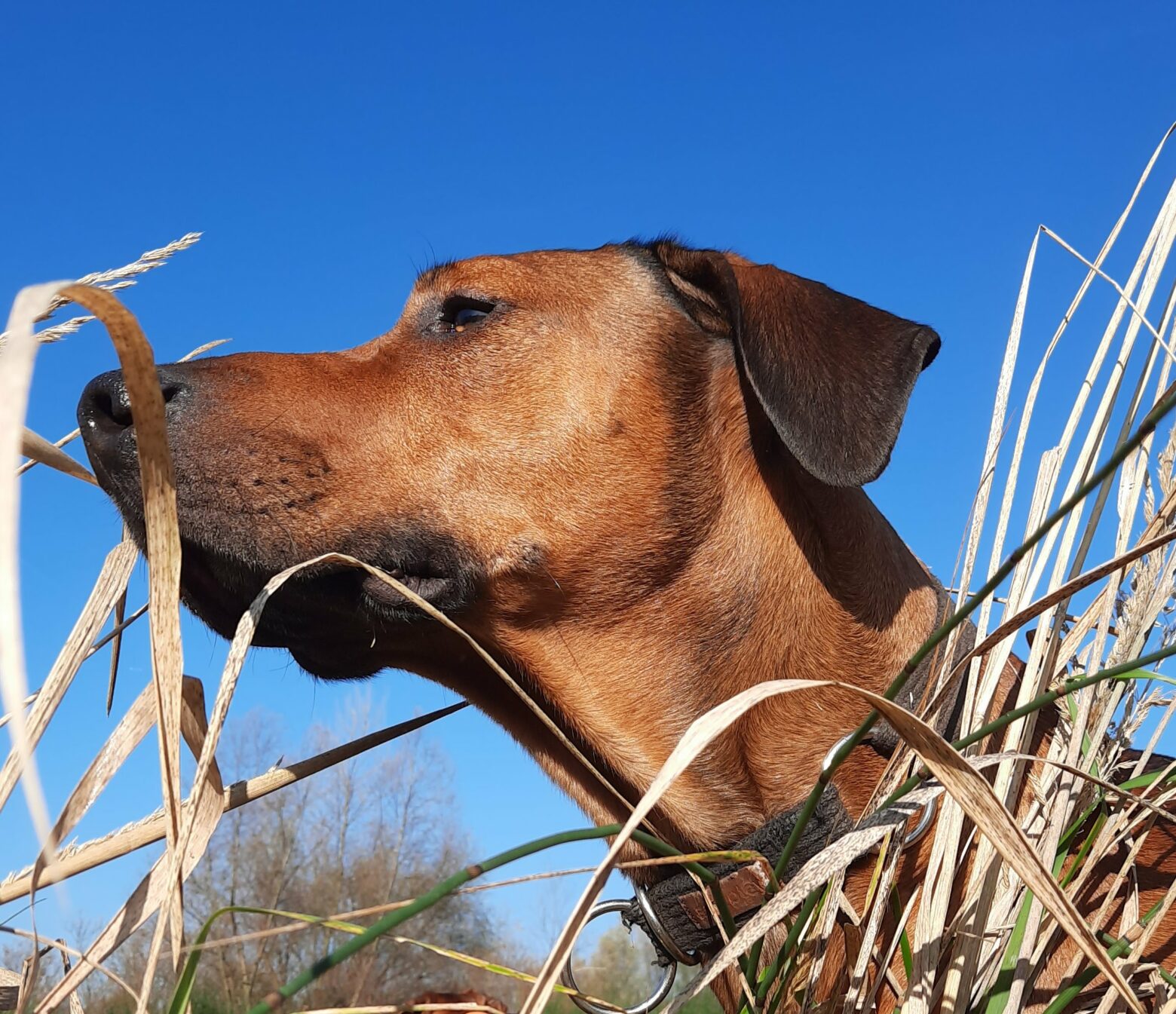 Visceral:
Nose black or brown. If the eyes are dark the tip of the nose must be black, if the eyes are amber must be brown.
Mug long, deep and strong.
Lips: the lip line is clearly marked, the lips adhere well to the jaws.
Jaws/dentition: Strong jaws, perfect scissor bite, full dentition, upper incassers closely overlap the lower incassers; incassers are perpendicular to the jaws.Teeth well developed, especially fanies.
Cheeks well carved.
Eyes moderately spaced, round, shiny and vivid, with a smart expression. Their color harmonizes with anointing.
Ears embedded quite high, medium in size and quite wide at the root. Gradually they narrow, and their end is slightly rounded. They are worn flat at the head.
Neck:
Quite long, strong, without a throat.
Trunk:
Strong back.
Lumbar strong, muscular and slightly arched.
Chest not very wide, but deep and roomy; its bottom line reaches to the elbows.
Pre-bust highlighted.
Ribs moderately arched, never barreled.
Tail:
Strong at the root, tapered towards the end, not thick, medium length. It should not be placed either too high or too low. Worn slightly bent upwards, but never twisted.
 Limb:
Limb:
Forelimbs perfectly straight, strong, with a strong bone. Elbows adhere to the chest. Seen from the profile are wider than seen on the front. Metacarpal strong, slightly sloping.
Shoulder blades oblique, clear and muscular, betraying speed.
Paws, compact, rounded with arched fingers and strong, elastic straps. Paws are protected by hair growing between the fingers and fingertips.
Hind limbs: strong and clearly scratched muscles; knee joints- in well angled, ankle joints strong, metatarsal quite short.
Traffic:
In the movement of the limbs are carried out in parallel, free and vigorous gait.
Hair cover:
Short and thick hair, with a smooth, glossy appearance, is neither woolly nor silky.
Anointing: from light wheat to red-faint. Slight white meanings on the fore breast and fingers are acceptable, but the excessive amount of white on the front of the breast, on the abdomen or on the paws higher than the fingers, constitutes a disadvantage. Dark mug and ears are acceptable. Any black hair dotted on the trunk and paws is definitely undesirable.
Height and weight:
Height at the withers: (desired)
- dogs 63 – 69 cm (25 – 27 inches),
- 61 – 66 cm (24 – 26 inches).
- dogs 36.5 kg (80 English pounds),
- 32 kg (70 English pounds).